ShopDreamUp AI ArtDreamUp
Deviation Actions






Description
Peace be to you guys and girls,
I found this article yesterday and thought it's nice to share it with you. hope you learn something...
By Hesham A. Hassaballa, March 27, 2009
Growing up, I was surrounded by the typical patriarchal family structure. My father was not a brutal tyrant, far from it. Nevertheless, the notion of the "man's role" and the "woman's role" abound throughout my upbringing. When it came time for me to marry, I wanted to be different. I wanted a different kind of marital relationship.
For many years now, I and countless other Muslim writers, academics, and activists, have worked tirelessly to combat the negative image of Islam and Muslims in the media and popular culture. Frequently, it is a story of repeated frustration and disappointment. Whenever it seems we make headway in our struggle against the misunderstanding of Islam, we get a news story the like of the murder of Aasiya Zubair (may God have mercy on her soul).
When news such as that breaks, we have to start all over again and try to shout over the hatemongers and Islamophobes. Again, it is maddeningly frustrating and disappointing. Yet, images, headlines, and soundbytes are far more powerful than articles, lectures, and blog posts. So are movies and television shows. And when it comes to portraying Muslim men, the image of the misogynistic tyrant is dominant.
Even in films that can be passed off as "pro-Muslim," such as Rendition, the police captain in the film is the same archetype: the tyrannical father figure whose is a dictator at home with his wife and daughter. It is a very powerful shaper of perception, and so many times, perception is reality. And it does have an effect on popular perception.
My wife wears the hijab, and many non-Muslims have the perception that I am making her wear it. Both of us have to constantly remind people that she wears it on her own accord, that I had no idea what her hair looked like when I first proposed to her. Yet, again, this stems from the ubiquitous notion in the media and popular culture that Muslim men are domineering monsters, oppressing their women at every chance they get.
This is terribly frustrating for me, as an American Muslim man. I don't like to be labeled, or even looked at, as an "oppressive husband" simply because I am Muslim. The problem is, however, that I have to contend with the fact that there are Muslim men who oppress their wives. There are Muslim men who abuse their wives and think Islam gives them the right to do so. There are Muslim men who murder their wives, daughters, and sisters in order to "defend the family honor." As much as I hate it, the filth of their sins stain me as well, and it is not right, fair, or just.
Whenever I learn of such terrible crimes committed by Muslim men against their sisters in faith, I wrack my brain in complete despair. Don't they know the example of the Prophet Muhammad (pbuh)? Don't they know that he was nothing but kind, compassionate, and merciful to his wives? Don't they realize that he helped his wives with their housework, took their advice on very important matters, and really treated them as his partner rather than his subservient? Don't they know of the scores of hadith that begin with "Treat your wives kindly..."? Do they think they are better than the Prophet Muhammad (pbuh) when they act like horrific tyrants?
As Muslim men and husbands, we must always look to and learn from the example of our beloved Prophet (pbuh). I am the first-generation son of immigrants to this country. Growing up, I was surrounded by the typical patriarchal family structure. My father was not a brutal tyrant, far from it. Nevertheless, the notion of the "man's role" and the "woman's role" abound throughout my upbringing. When it came time for me to marry, I wanted to be different. I wanted a different kind of marital relationship.
I didn't want my wife to "serve me." I didn't believe that my wife's place was "in the home." I wanted to build a lifelong partnership with her. As I grew older, I started to look more deeply into the example of the Prophet Muhammad (pbuh) and learn how I can be the best husband possible. It is difficult to treat this territory, being surrounded by uncles who ascribe to the "old way." In fact, I remember long ago I was at a picnic, sitting with a number of "uncles." I was doing something to help my wife, and one of the "uncles" berated me, in a friendly manner, for "serving" her like I did.
Yet, we must teach our young men - the future husbands of the Muslim community - that to "be a man" does not mean that you must mistreat your wife; that treating your wife with honor, respect, and kindness is not an "act of weakness"; that your wife is your life partner, not your cook, maid, and other things. We must erase this paternalistic notion of what it means to be a husband, and actually take advantage of the fact that our wives present us with an opportunity to go to Paradise if we treat them with the honor, respect, and kindness they deserve.
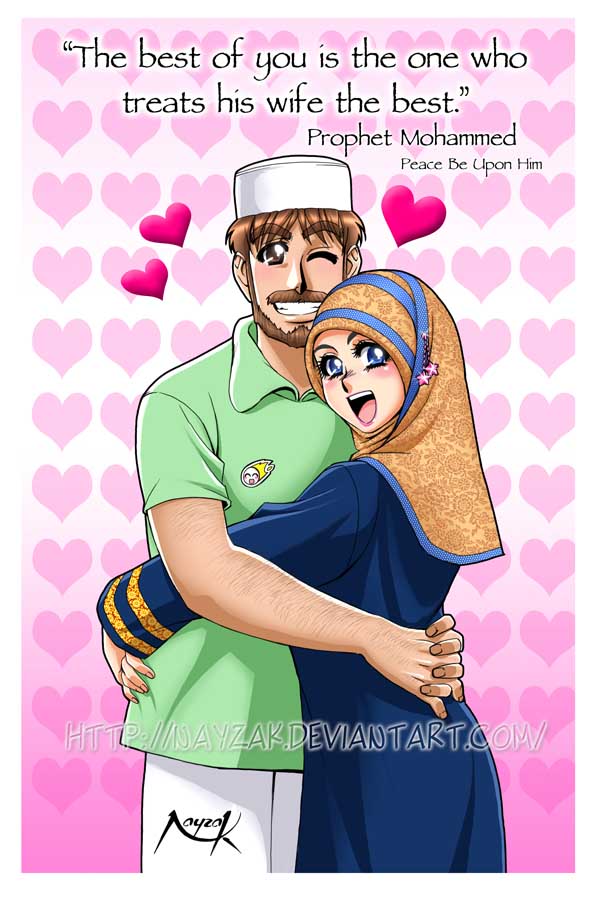
Going back to that picnic, when the uncle gave me grief for helping my wife, I said back to him, "The best of you is the one who treats his wife the best," the famous hadith of the Prophet Muhammad (pbuh). He did not have a response, and all he could do was laugh, but commending me at the same time. That is the standard by which we Muslim men must live. I am not a perfect husband, far from it. But I am trying, and I always try to remind myself of the Prophet's eternal words of wisdom: "The best of you is the one who treats his wife the best." Every day, I work to try to live up to this Prophetic challenge.
from altmuslimah.com: [link]
FROM THE SAME COLLECTION:
#01: Planting Trees: [link]
#02: Learning: [link]
#03: Good deeds: [link]
#04: the best of you:
#05: Animal care:[link]
#06:Getting Angry: [link]
#07:Cleanliness is from Faith: [link]
#08:Care for the orphans: [link]
#09:Visiting the sick: [link]
let's all fight ignorance with knowledge..
Peace be to you.
I found this article yesterday and thought it's nice to share it with you. hope you learn something...
By Hesham A. Hassaballa, March 27, 2009
Growing up, I was surrounded by the typical patriarchal family structure. My father was not a brutal tyrant, far from it. Nevertheless, the notion of the "man's role" and the "woman's role" abound throughout my upbringing. When it came time for me to marry, I wanted to be different. I wanted a different kind of marital relationship.
For many years now, I and countless other Muslim writers, academics, and activists, have worked tirelessly to combat the negative image of Islam and Muslims in the media and popular culture. Frequently, it is a story of repeated frustration and disappointment. Whenever it seems we make headway in our struggle against the misunderstanding of Islam, we get a news story the like of the murder of Aasiya Zubair (may God have mercy on her soul).
When news such as that breaks, we have to start all over again and try to shout over the hatemongers and Islamophobes. Again, it is maddeningly frustrating and disappointing. Yet, images, headlines, and soundbytes are far more powerful than articles, lectures, and blog posts. So are movies and television shows. And when it comes to portraying Muslim men, the image of the misogynistic tyrant is dominant.
Even in films that can be passed off as "pro-Muslim," such as Rendition, the police captain in the film is the same archetype: the tyrannical father figure whose is a dictator at home with his wife and daughter. It is a very powerful shaper of perception, and so many times, perception is reality. And it does have an effect on popular perception.
My wife wears the hijab, and many non-Muslims have the perception that I am making her wear it. Both of us have to constantly remind people that she wears it on her own accord, that I had no idea what her hair looked like when I first proposed to her. Yet, again, this stems from the ubiquitous notion in the media and popular culture that Muslim men are domineering monsters, oppressing their women at every chance they get.
This is terribly frustrating for me, as an American Muslim man. I don't like to be labeled, or even looked at, as an "oppressive husband" simply because I am Muslim. The problem is, however, that I have to contend with the fact that there are Muslim men who oppress their wives. There are Muslim men who abuse their wives and think Islam gives them the right to do so. There are Muslim men who murder their wives, daughters, and sisters in order to "defend the family honor." As much as I hate it, the filth of their sins stain me as well, and it is not right, fair, or just.
Whenever I learn of such terrible crimes committed by Muslim men against their sisters in faith, I wrack my brain in complete despair. Don't they know the example of the Prophet Muhammad (pbuh)? Don't they know that he was nothing but kind, compassionate, and merciful to his wives? Don't they realize that he helped his wives with their housework, took their advice on very important matters, and really treated them as his partner rather than his subservient? Don't they know of the scores of hadith that begin with "Treat your wives kindly..."? Do they think they are better than the Prophet Muhammad (pbuh) when they act like horrific tyrants?
As Muslim men and husbands, we must always look to and learn from the example of our beloved Prophet (pbuh). I am the first-generation son of immigrants to this country. Growing up, I was surrounded by the typical patriarchal family structure. My father was not a brutal tyrant, far from it. Nevertheless, the notion of the "man's role" and the "woman's role" abound throughout my upbringing. When it came time for me to marry, I wanted to be different. I wanted a different kind of marital relationship.
I didn't want my wife to "serve me." I didn't believe that my wife's place was "in the home." I wanted to build a lifelong partnership with her. As I grew older, I started to look more deeply into the example of the Prophet Muhammad (pbuh) and learn how I can be the best husband possible. It is difficult to treat this territory, being surrounded by uncles who ascribe to the "old way." In fact, I remember long ago I was at a picnic, sitting with a number of "uncles." I was doing something to help my wife, and one of the "uncles" berated me, in a friendly manner, for "serving" her like I did.
Yet, we must teach our young men - the future husbands of the Muslim community - that to "be a man" does not mean that you must mistreat your wife; that treating your wife with honor, respect, and kindness is not an "act of weakness"; that your wife is your life partner, not your cook, maid, and other things. We must erase this paternalistic notion of what it means to be a husband, and actually take advantage of the fact that our wives present us with an opportunity to go to Paradise if we treat them with the honor, respect, and kindness they deserve.
Going back to that picnic, when the uncle gave me grief for helping my wife, I said back to him, "The best of you is the one who treats his wife the best," the famous hadith of the Prophet Muhammad (pbuh). He did not have a response, and all he could do was laugh, but commending me at the same time. That is the standard by which we Muslim men must live. I am not a perfect husband, far from it. But I am trying, and I always try to remind myself of the Prophet's eternal words of wisdom: "The best of you is the one who treats his wife the best." Every day, I work to try to live up to this Prophetic challenge.
from altmuslimah.com: [link]
FROM THE SAME COLLECTION:
#01: Planting Trees: [link]
#02: Learning: [link]
#03: Good deeds: [link]
#04: the best of you:
#05: Animal care:[link]
#06:Getting Angry: [link]
#07:Cleanliness is from Faith: [link]
#08:Care for the orphans: [link]
#09:Visiting the sick: [link]
let's all fight ignorance with knowledge..
Peace be to you.
Image size
600x900px 95.13 KB
© 2010 - 2024 Nayzak
Comments190

Sura IV, sura IV, sura IV...
Comments have been disabled for this deviation